Spinoza on Climate Change?
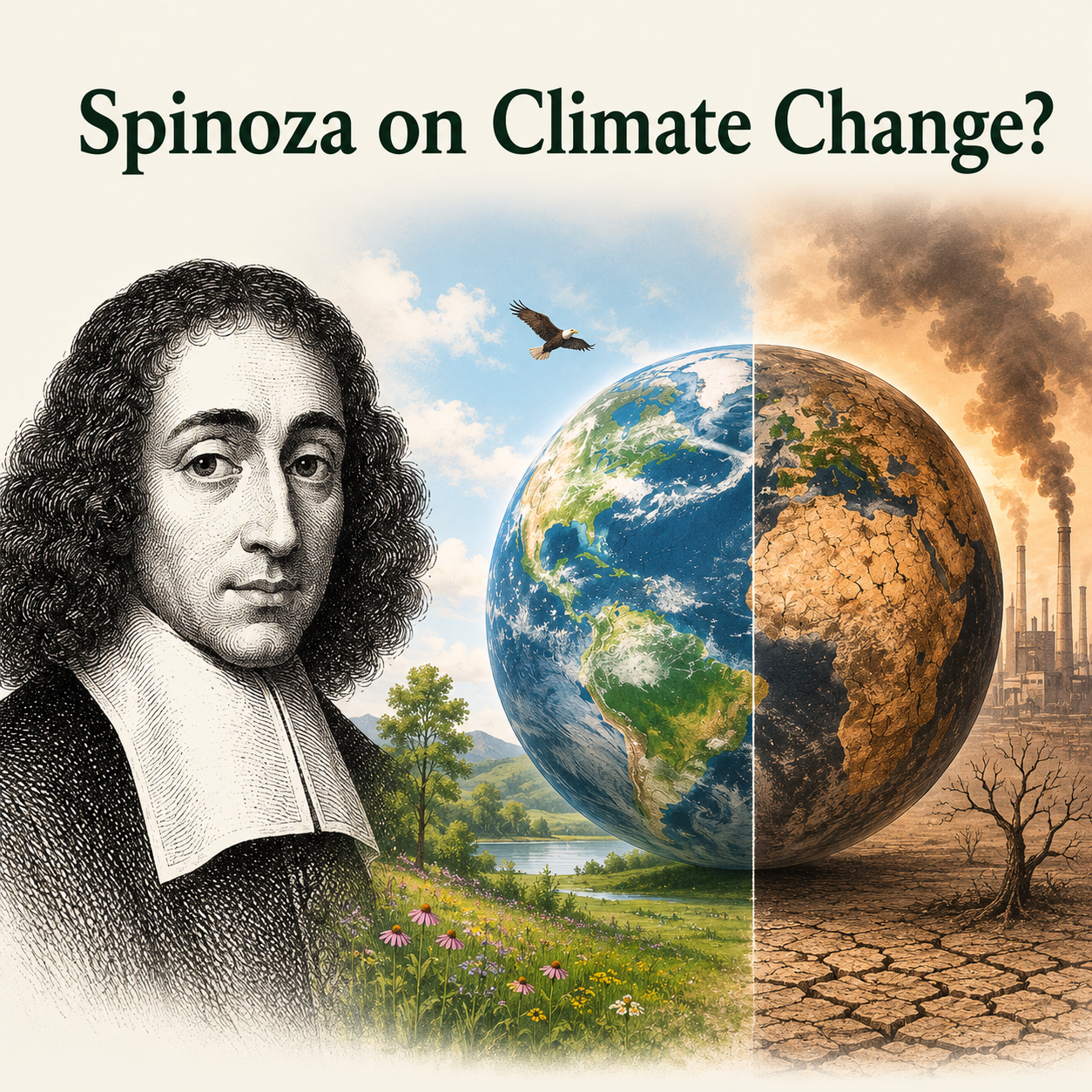 Let's look at six things:
- Nature is all there is
- The denial of teleology
- Adequate ideas
- Freedom through understanding
- Ethics without moralism
- Love of nature
Nature is all there is
Spinoza's central insight is that there is only one substance, which he calls "God or Nature" (Deus sive Natura). Everything that exists — including human beings, our factories, our carbon emissions, our political systems — is a mode of this single, self-caused reality. There is nothing outside Nature. From this perspective, climate change is not an external assault upon nature — it is an immanent process within Nature.
The denial of teleology
Spinoza is a strict determinist: "All things follow from the necessity of the divine nature" (Ethics I, P29). Nothing happens for a purpose. There is no cosmic plan, no Mother Earth "fighting back," no moral arc bending toward justice. Climate change, then, is not a punishment, a warning, or a test. It is simply what necessarily follows from prior causes: the discovery of coal and oil, the explosion of population, the economic structures that rewarded extraction. The rising seas and intensifying storms follow with the same inevitability as a stone rolling downhill.
Adequate ideas
Every thing, for Spinoza, strives to persevere in its being — this is the conatus. Ethics is grounded in this striving: "good" is what enhances our power of acting and persistence; "bad" is what diminishes it. Human civilization, in expanding through fossil fuels, was exercising its conatus — striving to grow, build, flourish. But Spinoza distinguishes between acting from adequate ideas (true understanding of causes) and acting from inadequate ideas (partial, confused understanding driven by passions). Climate change would represent, in Spinozan terms, the consequence of inadequate understanding: we pursued our preservation through means that, because we failed to grasp the larger causal network, ultimately undermine our persistence.
Freedom through understanding
For Spinoza, freedom is not free will (which he considers an illusion). Freedom is understanding necessity. We are free not when we escape the causal order, but when we comprehend it and act in alignment with it. Applied to climate change: genuine freedom would mean achieving an adequate idea of the planetary system — the carbon cycle, the feedback loops, the ecological interdependencies — and then acting in accordance with that understanding.
Ethics Without Moralism
One of the most distinctive things about what could be Spinoza's take on climate change is the absence of moralism. Spinoza doesn't think in terms of guilt, sin, or blame. He writes in Ethics III, Preface: "I shall consider human actions and appetites exactly as though I were considering lines, planes, and solids." It seems he would analyze climate change not as a moral failing but as a failure of understanding and power. Those who profit from extraction while causing destruction are not "evil" in a cosmic sense — they are trapped in inadequate ideas, driven by passions that they mistakenly believe serve their interest.
Love of nature
Spinoza's philosophy culminates in what he calls the intellectual love of God (Nature) — a joy born from understanding the necessary order of things, even those things we might fear or resist ~ the ice melting, the species vanishing, the storms intensifying — these are all, in Spinoza's view, expressions of Nature's infinite power. To intellectually love Nature is not to celebrate destruction, but to affirm that everything follows from the same necessity, and that our liberation lies in understanding this — not in raging against it emotionally or fantasizing about escaping it.
The intellectual love is simultaneously an active force: the more we understand the causal order, the more effectively we can act within it. Acceptance and transformation are, for Spinoza, the same gesture. We don't fight climate change out of fear or guilt; we address it because reason demands it as the path to greater power and persistence.