Seeds of Sinai

exploring nontheistic Jewish life

Returning to the Earth

Returning to the Earth: Green Burial from a Nontheistic Jewish Perspective

Death has always challenged us to ask what it means to live a meaningful life. While traditional Judaism often frames death through the lens of an afterlife, many contemporary Jews—including humanistic, secular, Reconstructionist, Renewal, and culturally Jewish communities—find meaning not in supernatural promises but in the enduring values of connection, memory, responsibility, and the natural cycles of life.

Home tahara and green burial offer an opportunity to reclaim ancient Jewish practices in ways that honor both our ancestors and our modern understanding of the world.

Returning to Simplicity

Jewish burial traditions developed around remarkable simplicity. The body was washed, lovingly cared for, wrapped in simple linen garments, placed in a plain wooden coffin—or sometimes directly in the earth—and buried as soon as practical. Wealth and status disappeared in death, affirming the equality of every human being.

Over time, commercial funeral practices have often moved us away from these values; green burial restores simplicity. The body is allowed to return naturally to the earth without embalming or unnecessary materials. The burial itself becomes an affirmation that humans are part of nature rather than separate from it.

Tahara as an Act of Love

The Hebrew word tahara is often translated as "purification," but from a nontheistic perspective it can be understood differently. Rather than preparing a soul for another world, tahara becomes a final act of tenderness for a person whose life has ended.

Washing the body is not about removing spiritual impurity. It is about expressing gratitude ~ fear gives way to intimacy. The body ceases to be something hidden away by professionals and instead becomes the familiar body of someone deeply loved. There is no need for elaborate ritual. Quiet washing, dressing in natural fibers, moments of silence, shared stories, or simply being present can all become expressions of kavod hamet—honoring the dead.

The Wisdom of Green Burial

Jewish tradition has reminded us that human beings come from the earth and return to it. Whether understood literally or poetically, this image reflects an ecological truth. Our bodies are composed of the same elements that circulate through forests, rivers, soil, plants, animals, and future generations. Green burial embraces this reality.

Instead of attempting to preserve the body it allows natural decomposition to nourish living ecosystems. A burial ground becomes not only a cemetery but also a protected landscape where wildlife, trees, native plants, and future visitors coexist.

For many secular Jews, we can honestly affirm that our atoms continue their ancient journey through the living world.

Sustainability as a Jewish Value

Jewish tradition repeatedly warns against needless waste and unnecessary destruction. The principle known as bal tashchit teaches restraint in our use of resources and encourages thoughtful stewardship of the world we inhabit.

Green burial expresses this value in a contemporary context ~ avoiding toxic embalming chemicals, minimizing manufactured materials, reducing land disturbance, and protecting natural habitats all reflect an ethic of environmental responsibility.

Choosing a burial that leaves a lighter ecological footprint becomes one final act of care—not only for the deceased but for future generations.

Reclaiming Death as Part of Life

Modern society often treats death as a medical event to be managed behind closed doors. Families may have little opportunity to see, touch, or care for the person who has died; home tahara gently challenges this separation ~ it reminds us that death is neither failure nor contamination. 

Participating in the care of the dead can deepen our appreciation for the living. It invites us to slow down, acknowledge loss, and accompany one another through grief with compassion rather than avoidance.
Environmental Benefits of Green (and Traditional) Burial

As more people seek sustainable ways to reduce their environmental impact, green burial has emerged as an ecofriendly alternative to traditional burial practices. Green burial, which is very much in harmony with traditional teachings, focuses on returning the body to the earth naturally, without the use of embalming chemicals, metal caskets, or concrete burial vaults.

Traditional burial in the United States uses an estimated 4.3 million gallons of embalming fluid, approximately 20 million board feet of hardwood, more than 60,000 tons of steel, and about 1.6 million tons of reinforced concrete for burial vaults each year. Green burials eliminate the need for embalming fluids and typically use biodegradable shrouds or simple wooden, wicker, or cardboard caskets, substantially reducing the demand for these materials.

Tahara: The History and Practice of Jewish Ritual Preparation of the Dead from a Nontheistic Jewish Perspective

A Final Act of Human Kindness

Among the oldest Jewish traditions is tahara—the ritual preparation of the dead for burial. For centuries, Jews have washed, clothed, and cared for those who can no longer care for themselves. While many understand tahara through the lens of traditional religious belief, the practice also speaks powerfully to Jews who understand Judaism primarily as a civilization, an ethical tradition, or a cultural inheritance rather than a system of supernatural beliefs.

From a nontheistic perspective, tahara is not about preparing a soul for the next world. It is about honoring a life that has ended, acknowledging the reality of death, and expressing the highest ideals of dignity, equality, and compassion.

Ancient Origins

The origins of tahara are difficult to pinpoint because the earliest Jewish communities left few descriptions of funeral customs. Biblical texts mention mourning, burial, and care for the dead but provide little instruction regarding ritual preparation.

By the Second Temple period (roughly 500 BCE–70 CE), washing the deceased before burial appears to have become customary. Over time, Jewish communities developed structured practices for preparing the dead that emphasized cleanliness, modesty, and respect. By the Middle Ages, these customs had become standardized throughout much of the Jewish world.

Although the details have varied across communities and centuries, the central purpose has remained remarkably consistent: to ensure that every person is treated with dignity in death.

Equality at the End of Life

One of the most enduring features of tahara is its insistence upon equality. Tradition recounts that in ancient times elaborate funerals placed heavy financial burdens on families seeking to demonstrate honor. The sage Rabban Gamliel requested that he be buried in simple linen garments, establishing a model of modest burial that gradually became the norm. 

Today the traditional white burial garments (tachrichim) remain intentionally simple. They erase outward signs of wealth, occupation, education, and social status, affirming that every human being deserves equal respect.

A nontheistic Jew may understand this not as a theological statement but as an ethical one. Death leaves behind the distinctions that often divide people during life. What remains is our shared humanity.

The Practice of Tahara

Although customs vary among communities, tahara generally follows a similar sequence.

  • The body is handled gently and respectfully. Care is taken to preserve privacy and avoid unnecessary conversation. The deceased is washed carefully, much as one would lovingly care for any human body entrusted to one's care.
  • Water is then poured continuously over the body in a symbolic act marking the completion of its preparation for burial. Traditional practice accompanies this act with prayers, while secular and nontheistic Jewish communities may instead observe silence or include readings that reflect the values and life of the deceased.
  • The body is carefully dried and dressed in plain white linen garments. Some communities include additional ritual items prescribed by religious tradition, while others simplify the practice to emphasize dignity rather than theology.
  • Finally, the deceased is placed into a simple wooden coffin—or, in some green burial traditions, wrapped in a biodegradable shroud for direct burial in the earth.

Throughout the process, every action is deliberate and gentle, expressing care for the person whose life has ended.

The Greatest Kindness

Jewish tradition describes caring for the dead as chesed shel emet—"the truest kindness"—because it cannot be repaid. Even without accepting the theological assumptions behind that phrase, its ethical insight remains compelling. Modern society often values relationships according to reciprocity and usefulness. Tahara offers another model: caring for another person simply because every human being deserves care.

Community Responsibility

Tahara reflects a broader Jewish understanding that caring for one another extends beyond life itself. Every community chooses how it will respond to death ~ Jewish tradition has long been that the deceased should be treated with modesty, and respect, and that grieving families should not bear this responsibility alone.

From a nontheistic perspective, this responsibility arises not from divine command but from human obligation. We care for one another because we belong to one another.

Death as Part of Nature

Traditional Jewish theology often interprets tahara as preparing the deceased before God. A nontheistic perspective instead understands death as the natural conclusion of a biological life. The human body, composed of the same elements as the earth itself, eventually returns to natural cycles. Green burial practices reflect this understanding particularly well, allowing the body to return naturally to the soil without unnecessary intervention.In this view, tahara is not preparation for another world but a respectful acknowledgment of our place within the living world.

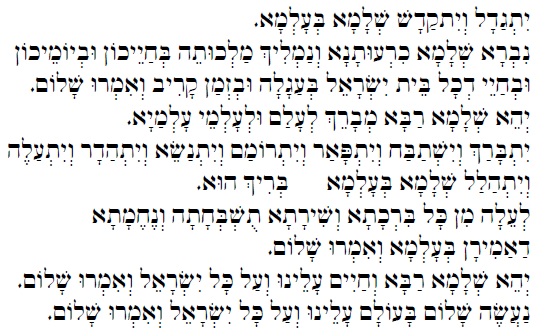
Rabbi Sherwin Wine ~ A Humanistic Kaddish

Humanistic Kaddish image

YIT-GAD-DAL V’-YIT-KAD-DASH SH’-LA-MA B’A-L’MA.
NIV-RA SH’-LA-MA KHEE-R’-OO-TA-NA V’-NAM-LEEKH MAL-KHOO-TAY
B’KHIE-YAY-KHON OO-V’-YO-MAY-KHON OO-V’-KHIE-YAY D’-KHOL BAYT
YIS-RA-EL BA-AH-GA-LA OO-VEE-Z’-MAN KA-REEV. V’-EEM-ROO SHALOM.
Y’-HAY SHLA-MA RAB-BA M’-VA-RAYKH L’-A-LAM OO-L’-AL-MAY AL-MIEYA.
YIT-BA-RAKH V’-YISH-TA-BAKH YIT-PA-AR V’-YIT-RO-MAM V’-YIT-NASSAY
V’-YIT-HA-DAR V’-YIT-AH-LE V’-YIT-HAL-LAL SH’-LA-MA B’-AL-MA B’-REEKH HOO.
L-AY-LA MIN KOL BIR-KHA-TA V’-SHEE-RA-TA TOOSH-B’-KHA-TA V’-NEHE-
MA-TA DA-A-MEE-RAN B’-AL-MA. V-EE-M’-ROO SHA-LOM.
Y’-HAY SH’-LA-MA RAB-BA V’-HIE-YEEM A-LAY-NOO V’-AL KOL YIS-RA-EL
V’-EEM-ROO SHA-LOM
NA-A-SE SHA-LOM BA-O-LAM. A-LAY-NOO V’-AL KOL YIS-RA-EL V’-EEMROO SHA-LOM.

Wonderful is peace in the world. Let us create a peaceful world and let us establish its kingdom now and in the future. May peace come upon us to bless our lives. May we always continue to honor peace in the world even though no praise can equal the importance of its reality. May peace and life prevail for us and for all Israel. Let us work to create peace here on earth for all people, and let us say, Peace.