Many religious and spiritual traditions have developed practices that allow an individual to mark the phases of the moon without needing a congregation or formal clergy. These practices often connect the lunar cycle with themes of time, renewal, gratitude, reflection, and the rhythms of nature. If your interest is in developing a nontheistic or Humanistic Jewish approach, many of these practices can be adapted while emphasizing the natural cycles of the moon rather than supernatural beliefs.
New Moon (Beginning of the Lunar Month)
The new moon is perhaps the most widely observed lunar moment across cultures.
Common solitary practices include:
- Lighting a candle to mark the beginning of a new cycle.
- Going outdoors after sunset to look for the first visible crescent.
- Setting intentions or goals for the coming month.
- Reading poetry about renewal or nature.
- Thinking about what one hopes to cultivate.
- Beginning a new project or habit.
- Planting seeds or tending a garden.
Jewish inspiration
Historically, Rosh Chodesh (the New Moon) became a minor festival marked by additional prayers and, traditionally, reduced work for women. A solitary, secular version might include:
- observing the first crescent moon,
- reading Psalm 104 as nature poetry,
- reflecting on the previous month,
- recording seasonal observations,
- making a commitment to one act of repair or kindness.
Waxing Moon (Growth)
As the moon grows brighter:
- learn something new each evening,
- spend time developing a skill,
- cultivate relationships,
- water plants or work in a garden,
- keep a gratitude journal.
The symbolism is one of increasing light and possibility.
Full Moon
Many traditions celebrate the full moon because it is the easiest lunar phase to observe.
Solitary practices include:
- taking a moonlit walk,
- eating a festive meal outdoors,
- reading sacred or inspiring literature,
- meditating in silence,
- practicing gratitude,
- observing wildlife.
Jewish connections
Several biblical festivals originally coincided with the full moon:
- Passover
- Sukkot
- Tu Bishvat (in rabbinic calculation, though not always visibly full)
Agriculturally these periods coincide with important seasonal transitions rather than merely dates on a calendar.
Waning Moon
As the moon decreases:
- forgive old grievances,
- finish unfinished work,
- compost garden waste,
- simplify commitments,
- reflect on lessons learned.
Many traditions associate the waning moon with release rather than loss.
Dark Moon
The nights before the new crescent are among the darkest.
Practices include:
- silence,
- meditation,
- limiting artificial light,
- contemplating mortality,
- remembering ancestors,
- resting from unnecessary activity.
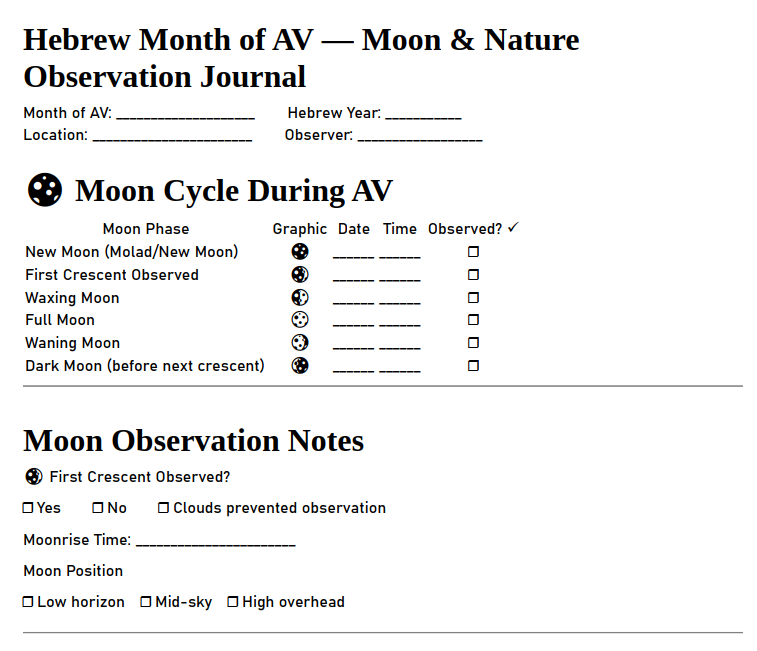
Monthly Nature Observation
One of the oldest lunar religious activities is simply paying attention.
Each month one might record:
- first crescent observed
- moonrise time
- weather
- flowering plants
- migrating birds
- insects
- crop development
- tides (if nearby)
- personal mood
This transforms the lunar calendar into a record of living within nature.
Monthly Blessings
Many traditions include blessings connected to the moon.
A nontheistic adaptation might say:
We welcome another month.
The moon reminds us that life unfolds in cycles.
As its light returns, may our understanding grow.
As its light wanes, may we let go of what no longer serves.
We are grateful to belong to the living world.