Seeds of Sinai

a committed secular Jewish life

A humanist reading of כִּ֥י מִמֶּ֖נָּה לֻקָּ֑חְתָּ


 A humanist reading of כִּ֥י מִמֶּ֖נָּה לֻקָּ֑חְתָּ  — ki mimenah lukakhta,

"for from it you were taken" (Genesis, 3rd chapter)  


ki mimenah lukakhta — For from it you were taken.

I am not separate from the world.
I am taken from the same earth as every human being,
from the same living world as the animals,
from the waters, the plants, the soil, and the air.

My life is one life among countless lives.
My body is made from the world around me,
sustained by relationships I did not create,
and dependent upon forms of life I will never see.

I am part of humanity,
the lives of other people,
the lives of animals and plants,
the health of rivers, forests, oceans, and soil—
none exist entirely apart.

ki mimenah lukakhta...
From this earth I was taken.
To this earth I belong.
For the short span of my life,
I am one particular expression of a larger existence.

What happens to the whole touches each  individual.
What happens through the individual becomes part of the whole.

I am not the center of life.
I am a participant in it.


Spinoza on Climate Change?

Let's look at six things:

  1. Nature is all there is
  2. The denial of teleology
  3. Adequate ideas
  4. Freedom through understanding
  5. Ethics without moralism
  6. Love of nature

Nature is all there is 

Spinoza's central insight is that there is only one substance, which he calls "God or Nature" (Deus sive Natura). Everything that exists — including human beings, our factories, our carbon emissions, our political systems — is a mode of this single, self-caused reality. There is nothing outside Nature. From this perspective, climate change is not an external assault upon nature — it is an immanent process within Nature. 

The denial of teleology

Spinoza is a strict determinist: "All things follow from the necessity of the divine nature" (Ethics I, P29). Nothing happens for a purpose. There is no cosmic plan, no Mother Earth "fighting back," no moral arc bending toward justice. Climate change, then, is not a punishment, a warning, or a test. It is simply what necessarily follows from prior causes: the discovery of coal and oil, the explosion of population, the economic structures that rewarded extraction. The rising seas and intensifying storms follow with the same inevitability as a stone rolling downhill.

Adequate ideas

Every thing, for Spinoza, strives to persevere in its being — this is the conatus. Ethics is grounded in this striving: "good" is what enhances our power of acting and persistence; "bad" is what diminishes it. Human civilization, in expanding through fossil fuels, was exercising its conatus — striving to grow, build, flourish. But Spinoza distinguishes between acting from adequate ideas (true understanding of causes) and acting from inadequate ideas (partial, confused understanding driven by passions). Climate change would represent, in Spinozan terms, the consequence of inadequate understanding: we pursued our preservation through means that, because we failed to grasp the larger causal network, ultimately undermine our persistence. 

Freedom through understanding

For Spinoza, freedom is not free will (which he considers an illusion). Freedom is understanding necessity. We are free not when we escape the causal order, but when we comprehend it and act in alignment with it. Applied to climate change: genuine freedom would mean achieving an adequate idea of the planetary system — the carbon cycle, the feedback loops, the ecological interdependencies — and then acting in accordance with that understanding.

Ethics Without Moralism

One of the most distinctive things about what could be Spinoza's take on climate change is the absence of moralism. Spinoza doesn't think in terms of guilt, sin, or blame. He writes in Ethics III, Preface: "I shall consider human actions and appetites exactly as though I were considering lines, planes, and solids."   It seems he would analyze climate change not as a moral failing but as a failure of understanding and power. Those who profit from extraction while causing destruction are not "evil" in a cosmic sense — they are trapped in inadequate ideas, driven by passions that they mistakenly believe serve their interest.

Love of nature

Spinoza's philosophy culminates in what he calls the intellectual love of God (Nature) — a joy born from understanding the necessary order of things, even those things we might fear or resist ~ the ice melting, the species vanishing, the storms intensifying — these are all, in Spinoza's view, expressions of Nature's infinite power. To intellectually love Nature is not to celebrate destruction, but to affirm that everything follows from the same necessity, and that our liberation lies in understanding this — not in raging against it emotionally or fantasizing about escaping it.

The intellectual love is simultaneously an active force: the more we understand the causal order, the more effectively we can act within it. Acceptance and transformation are, for Spinoza, the same gesture. We don't fight climate change out of fear or guilt; we address it because reason demands it as the path to greater power and persistence.

A Daily Practice ~ counting the day of the lunar month

A Talmudically inspired passage to recite daily:

Today is the ___ day of this lunar month of ___. As ancestors sanctified the new moon through careful witness, so we mark this day of the month. May we participate in what is growing, what is fading, and what continues.

This passage reflects three Talmudic and traditional ideas:

  1. the importance of attentiveness to the moon;

  2. lunar cycles structure communal life;

  3. renewal unfolds day by day through observation rather than as an abstraction.

1) From a Talmudic passage in Sukkah 29a:

"ישראל מונין ללבנה" ~ "Israel counts according to the moon."

2) From a Talmudic passage in Rosh Hashanah 24a–25b:

When witnesses arrive:

  • the new month is declared
  • messengers are dispatched throughout different communities
  • communities know to celebrate festivals accordingly

3) From a Talmudic passage in Sanhedrin 41b–42a:

One may bless the moon only after actually seeing it ~ a blessing is not recited because calculations say the moon exists, but rather only after the new moon is seen.

A Non-Theistic Midrash on the Moon

The sages asked: Why was the calendar entrusted to the moon rather than to the sun?

One answered: Because the sun teaches daily effort and the moon rests.

Another answered: Because the sun appears unchanged, but the moon changes.

The teacher rose and said:

Neither has understood the matter completely. The moon appears to grow and diminish, yet no one imagines that part of it has been lost. Its fullness remains even when hidden from sight. It is our position that changes, not the moon itself. The moon is like Acceptance.

The disciples asked: If the Acceptance never changes, why do we sometimes feel close to it and at other times abandoned?

The teacher replied: 

When clouds cover the moon, do you say that the moon has ceased to exist? When the new moon cannot be seen, do you mourn its destruction? You know that what cannot be seen has not ceased to be.

Observing New Moons and...

Many religious and spiritual traditions have developed practices that allow an individual to mark the phases of the moon without needing a congregation or formal clergy. These practices often connect the lunar cycle with themes of time, renewal, gratitude, reflection, and the rhythms of nature. If your interest is in developing a nontheistic or Humanistic Jewish approach, many of these practices can be adapted while emphasizing the natural cycles of the moon rather than supernatural beliefs.

New Moon (Beginning of the Lunar Month)

The new moon is perhaps the most widely observed lunar moment across cultures.

Common solitary practices include:

  • Lighting a candle to mark the beginning of a new cycle.
  • Going outdoors after sunset to look for the first visible crescent.
  • Setting intentions or goals for the coming month.
  • Reading poetry about renewal or nature.
  • Thinking about what one hopes to cultivate.
  • Beginning a new project or habit.
  • Planting seeds or tending a garden.

Jewish inspiration

Historically, Rosh Chodesh (the New Moon) became a minor festival marked by additional prayers and, traditionally, reduced work for women. A solitary, secular version might include:

  • observing the first crescent moon,
  • reading Psalm 104 as nature poetry,
  • reflecting on the previous month,
  • recording seasonal observations,
  • making a commitment to one act of repair or kindness.

Waxing Moon (Growth)

As the moon grows brighter:

  • learn something new each evening,
  • spend time developing a skill,
  • cultivate relationships,
  • water plants or work in a garden,
  • keep a gratitude journal.

The symbolism is one of increasing light and possibility.


Full Moon

Many traditions celebrate the full moon because it is the easiest lunar phase to observe.

Solitary practices include:

  • taking a moonlit walk,
  • eating a festive meal outdoors,
  • reading sacred or inspiring literature,
  • meditating in silence,
  • practicing gratitude,
  • observing wildlife.

Jewish connections

Several biblical festivals originally coincided with the full moon:

  • Passover
  • Sukkot
  • Tu Bishvat (in rabbinic calculation, though not always visibly full)

Agriculturally these periods coincide with important seasonal transitions rather than merely dates on a calendar.


Waning Moon

As the moon decreases:

  • forgive old grievances,
  • finish unfinished work,
  • compost garden waste,
  • simplify commitments,
  • reflect on lessons learned.

Many traditions associate the waning moon with release rather than loss.


Dark Moon

The nights before the new crescent are among the darkest.

Practices include:

  • silence,
  • meditation,
  • limiting artificial light,
  • contemplating mortality,
  • remembering ancestors,
  • resting from unnecessary activity.

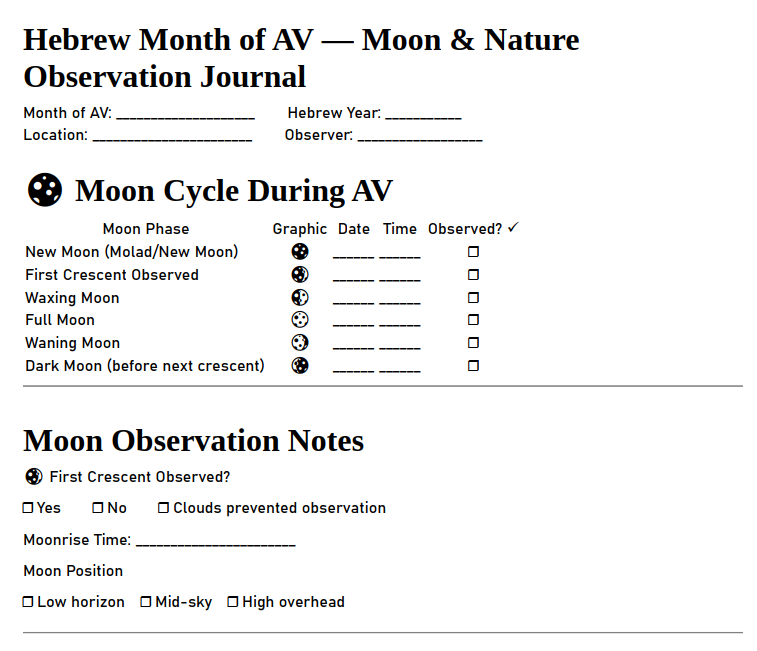
Monthly Nature Observation

One of the oldest lunar religious activities is simply paying attention.

Each month one might record:

  • first crescent observed
  • moonrise time
  • weather
  • flowering plants
  • migrating birds
  • insects
  • crop development
  • tides (if nearby)
  • personal mood

This transforms the lunar calendar into a record of living within nature.


Monthly Blessings

Many traditions include blessings connected to the moon.

A nontheistic adaptation might say:

We welcome another month.

The moon reminds us that life unfolds in cycles.

As its light returns, may our understanding grow.

As its light wanes, may we let go of what no longer serves.

We are grateful to belong to the living world.